Powerful Existing Environment Capture
Script Driven Multi-Schema Export
The Portable Schemation Export utility can accept a set of schema names, a list of object name regular expressions (used as filters), and a target database connection. With a single execution, it generates a complete Schemation Directory Structure, including object DDL, associated data, and a security map.
It automates the externalization of your environment’s DDL across multiple schemas—capturing cross-schema grants, synonyms, packages, functions, procedures, tables, and more. Everything needed to fully recreate your environment.
Unlike Oracle’s native export utilities, however, the output is entirely text-based and locally editable—including the data—giving you full transparency and control.
Editable Data Export
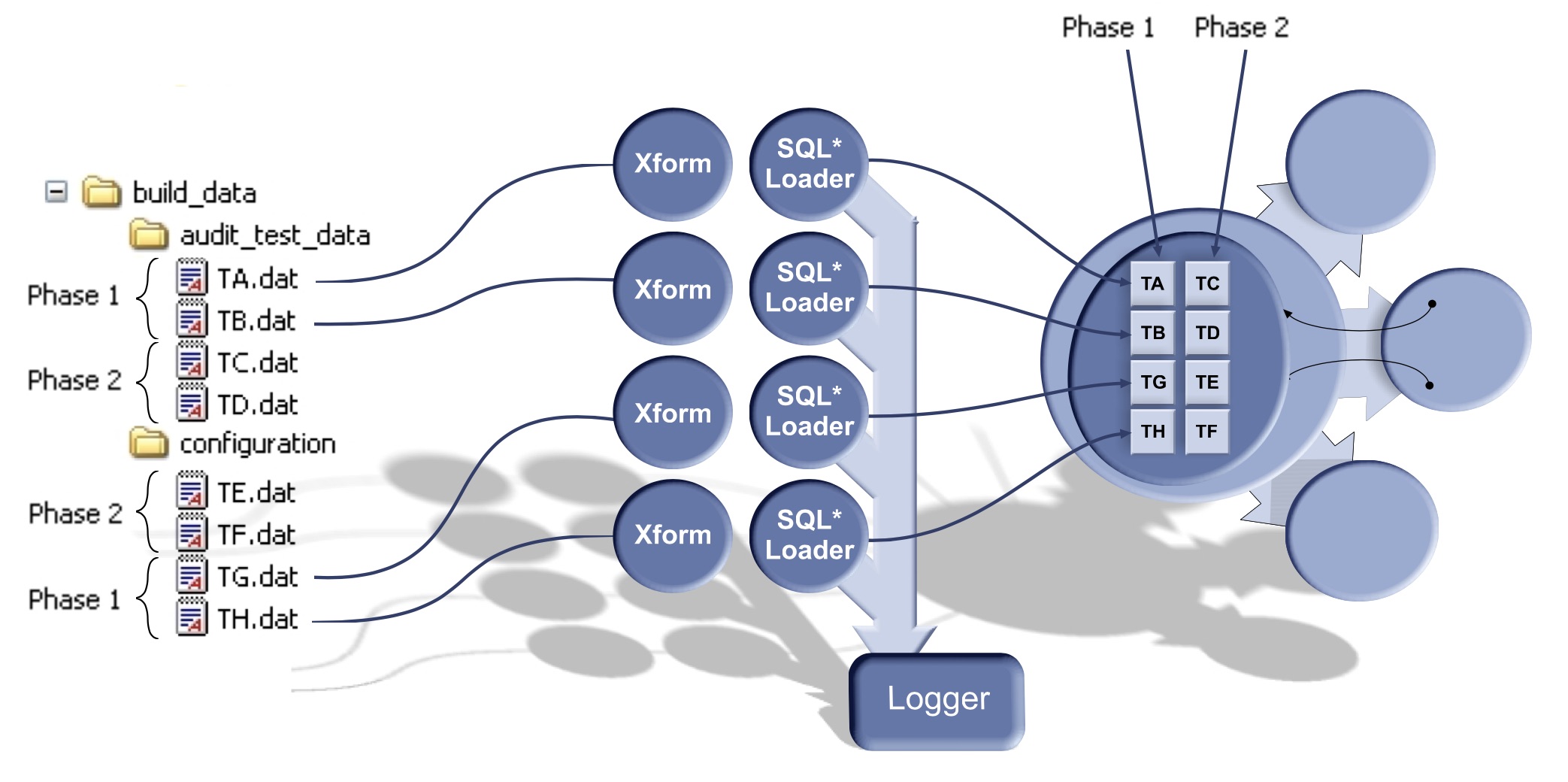
The Portable Schemation Export utility accepts several parameters, including a file containing a set of WHERE clauses. Using this input, it systematically generates pipe-separated data files, each prefixed with the corresponding table and column headers.
These files are saved in the build_data directory, ready to be used as a named dataset in a Schemation Build.
Even BLOB data—whether binary or character—can be exported in this format, providing the flexibility to view and modify any content as needed.
Editable DDL Export
The Portable Schemation Export utility allows you to define, within minutes, a set of objects from multiple schemas for externalization as DDL commands. The utility analyzes the interdependencies among your objects across schemas and generates a set of files that build all objects in the correct sequence.
All relationships between objects across schemas are captured in the Schemation Security Map File, which is automatically generated to include all extracted objects.
Automatic Genericization
Schemation manages environments in which schema names are derived from the environment name itself. Every schema within an environment includes the environment name as a prefix. For example, an environment named BIS_GEN might contain schemas like BIS_GEN_AUD, BIS_GEN_WEB, and BIS_GEN_CON. This consistent naming convention clearly associates all schemas with their respective environment.
When externalizing code originally developed in schemas with fixed names, Schemation automatically generalizes these references. The mapping between source schema names and their Schemation equivalents is specified in the parameter list provided to the Portable Export utility. During export, if Schemation detects hardcoded schema names in the code, it replaces them according to the defined mappings. For instance, a reference to WEBACCESS could be transformed into {PENV}_WEB. This genericization removes hardcoded dependencies, making the code easier to deploy across multiple environments.